


 Parent Handbook (246 Kb)
 download
 Child Care Checklist (95 KB)
 Agreement Form (94 KB)
 Monthly Billing Chart (95 KB)
 NS-11B, Block-E, Beta 1, Greater Noida, 201310
 +91 87500 00384
 official@kidzeebetal.com
 Mon-Fri: 9:00 am – 5:00 pm

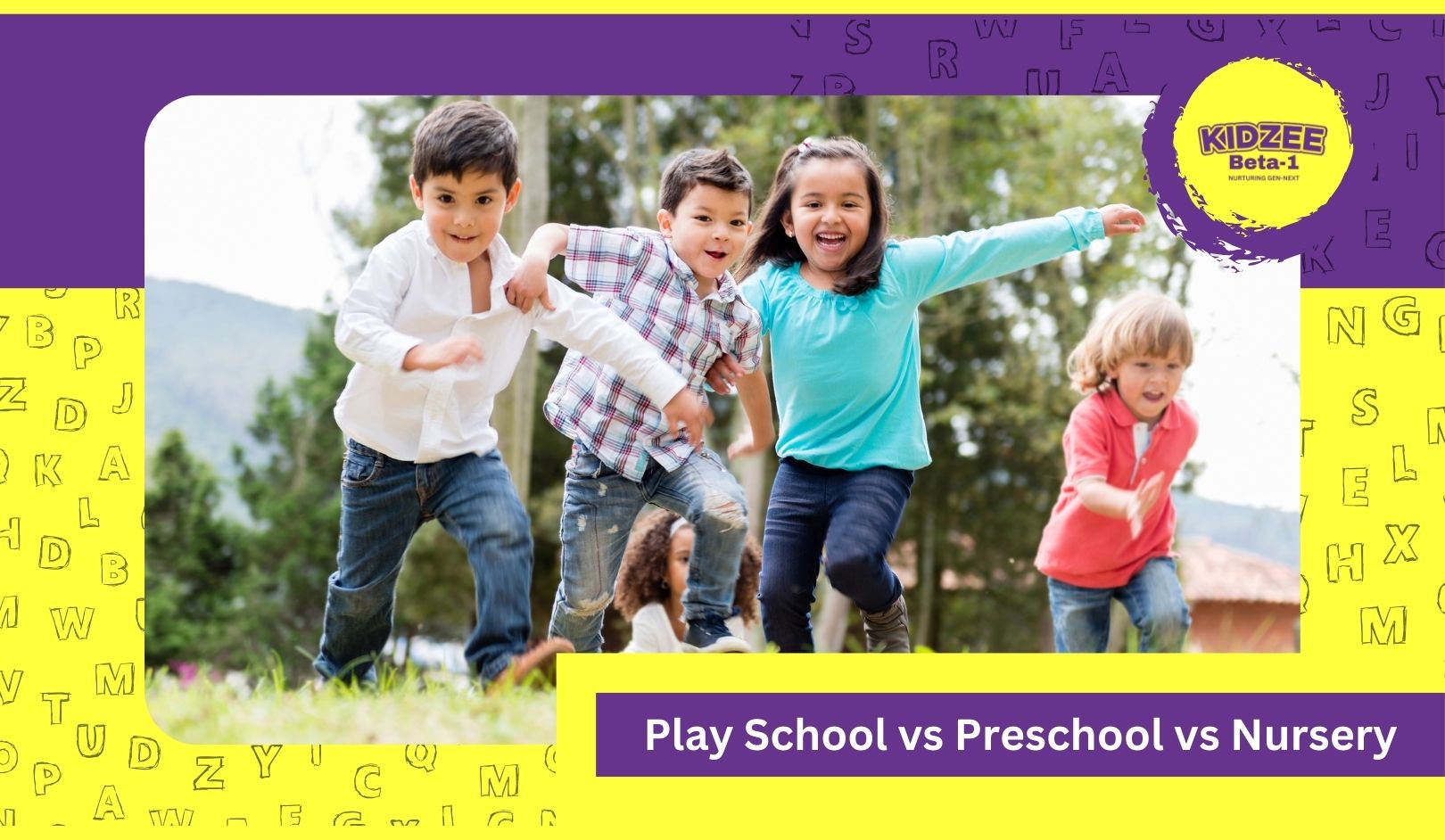
Play School vs Preschool vs Nursery: What to Choose for Your Child
Choosing the right first school for your child can feel exciting and confusing at the same time. Parents often hear three terms everywhere - play school, preschool, and nursery - and many assume they’re the same. They’re related, yes, but each one serves a slightly different purpose in your child’s early learning journey.
At Kidzee Beta 1 (Greater Noida), we meet parents daily who ask:
-
“Should we start with play school or straight to nursery?”
-
“What’s the right age?”
-
“Will my child be ready?”
-
“Which option is best for my child’s personality and development?”
This detailed guide will help you understand the differences, what to choose, and how Kidzee Beta 1 supports your child at every step.
Why This Decision Matters More Than Parents Think
Your child’s first schooling experience isn’t just about alphabets and numbers. It shapes:
-
Confidence and independence
-
Social skills and emotional strength
-
Communication and language development
-
Curiosity, creativity, and thinking skills
-
Love for learning
When the environment matches your child’s age and readiness, learning becomes joyful instead of stressful.
First, Let’s Simplify the Terms
Here’s the easiest way to understand it:
-
Play School - gentle first step into a learning environment
-
Preschool - structured early learning focused on school readiness
-
Nursery - a level/class (usually part of preschool) focused on foundational academics + routine
Different schools use these terms differently. But the intent remains: support early development in age-appropriate stages.
What Is a Play School?
A play school is usually the first formal exposure a child gets to learning outside home. It’s designed for toddlers who are still learning how to:
-
stay away from parents
-
interact with new people
-
follow simple instructions
-
build routines
-
explore safely
-
express feelings and needs
Typical Age for Play School
1.5 to 2.5 years (can vary slightly)
What Happens in Play School?
Play school focuses on:
-
sensory play (touch, sound, colors, shapes)
-
music, rhyme time, and movement
-
storytelling and picture talk
-
basic fine motor activities (scribbling, stacking, clay)
-
social play (sharing, turn-taking)
-
emotional bonding with teachers
It’s more about development than academics.
Best For:
-
children who are shy or strongly attached to parents
-
first-time schoolers
-
parents who want a safe start with a gentle routine
-
kids who need time to build social comfort
What Is Preschool?
A preschool is a broader stage that may include multiple levels like:
-
Playgroup
-
Nursery
-
LKG
-
UKG
Preschool aims to develop school readiness skills like:
-
listening and comprehension
-
speaking clearly
-
early literacy foundations
-
number concepts
-
routine, discipline, and classroom behavior
-
motor coordination
-
emotional control and social maturity
Typical Age for Preschool
Usually from 2 to 5 years.
What Happens in Preschool?
Preschool is a blend of:
-
play-based learning
-
structured activities
-
early foundational learning
-
creative expression
-
thematic learning (animals, seasons, body parts, transport, etc.)
At a good preschool, learning still feels like play - but with purpose.
Best For:
-
children who are ready for a routine
-
parents who want school readiness
-
kids who enjoy activities, stories, and structured play
-
working parents who want productive engagement
What Is Nursery?
Nursery is often misunderstood.
In many schools, Nursery is a class/level within preschool that sits between playgroup and LKG.
Nursery usually includes:
-
more structured learning
-
language development
-
pre-writing skills
-
early number concepts
-
stronger routine and independence training
Typical Age for Nursery
3 to 4 years (sometimes 2.5+ depending on school)
What Happens in Nursery?
In Nursery, children start preparing for formal schooling by learning:
-
recognizing letters and sounds
-
vocabulary building
-
pre-writing strokes
-
counting and basic patterns
-
coloring and tracing
-
speaking in a group
-
following classroom rules
Still, the best nursery programs do this through play, stories, and activities - not pressure.
Key Differences - Play School vs Preschool vs Nursery
1) Focus Area
-
Play School: comfort + social skills + exploration
-
Preschool: foundational learning + holistic development
-
Nursery: structured readiness + early literacy/numeracy
2) Routine Structure
-
Play School: flexible, gentle routines
-
Preschool: balanced routine with learning blocks
-
Nursery: more classroom-like routine
3) Academic Learning
-
Play School: minimal academics
-
Preschool: foundational concepts
-
Nursery: stronger academic foundation (still age-appropriate)
4) Independence Expectation
-
Play School: learn separation slowly
-
Preschool: build independence gradually
-
Nursery: more independence expected
Which One Should You Choose for Your Child?
The correct choice depends on age + readiness + personality.
If your child is 1.5 to 2.5 years
Choose Play School if:
-
child is anxious away from parents
-
needs social comfort
-
cries during separation
-
doesn’t follow routine yet
-
is learning basic communication
At Kidzee Beta 1, this stage is handled with warmth, patience, and gentle transitions.
If your child is 2.5 to 3.5 years
You can choose Preschool (Playgroup/Nursery) based on readiness.
Choose Preschool if your child:
-
can stay away from parents with manageable crying
-
responds to simple instructions
-
enjoys songs, rhymes, and group activities
-
is curious and interactive
If your child is 3 to 4 years
Nursery is usually a great fit if your child:
-
can sit for short group learning
-
speaks basic sentences
-
can eat and manage basic needs
-
shows interest in books, coloring, counting
A Simple Readiness Checklist for Parents
Your child may be ready for nursery/preschool if they can:
-
understand simple instructions
-
express hunger/thirst/toilet needs
-
play near other children
-
stay away from parents for short durations
-
manage basic self-help skills (with support)
If not, play school is often the most supportive first step.
What Parents Commonly Get Wrong (And How to Avoid It)
Mistake 1: Starting Too Early for “Competition”
Early pressure does not create smart kids - it creates anxious kids.
Start when your child shows readiness.
Mistake 2: Choosing Based on “Big School Style”
A big building doesn’t equal good learning.
A good play school means:
-
caring teachers
-
safe environment
-
structured play
-
emotional nurturing
-
development-focused learning
Mistake 3: Expecting Too Much Too Soon
At age 2-3, children are learning to:
-
communicate
-
regulate emotions
-
share
-
follow routine
That is education too.
Why Kidzee Beta 1 Is a Preferred Choice in Greater Noida
Kidzee has built a strong reputation in early childhood education, and Kidzee Beta 1 focuses on learning that’s:
-
child-centric
-
play-based
-
skill-driven
-
emotionally supportive
-
parent-partnered
What Makes Kidzee Beta 1 Different?
1) A Safe and Happy Environment
Children learn best when they feel safe and loved. Our environment is designed for comfort, hygiene, and joyful exploration.
2) Trained Educators Who Understand Child Psychology
Our teachers don’t just “teach.” They guide, nurture, and observe development patterns.
3) Balanced Routine Without Pressure
We focus on discipline and routine, but not on pushing academics early.
4) Strong Communication and Parent Updates
Parents are kept informed about:
-
progress
-
behavioral patterns
-
social development
-
language improvements
5) Foundation for School Readiness
Our curriculum helps children transition smoothly into nursery, LKG, UKG and beyond.
What Will Your Child Learn (Without Stress)?
In Play School
-
communication and vocabulary
-
independence habits
-
creative exploration
-
movement and coordination
-
social adjustment
-
emotional bonding
In Preschool
-
phonics and language foundation
-
pre-writing and motor skills
-
number concepts
-
storytelling and comprehension
-
creative thinking
-
classroom readiness
In Nursery
-
structured activity learning
-
stronger literacy and numeracy foundation
-
improved attention span
-
confidence in speaking
-
better behavior and routine
How to Choose the Best Play School in Greater Noida
When parents search “best play school in Greater Noida,” the best answer is the school that offers:
-
clean and safe campus
-
trained teachers
-
age-appropriate curriculum
-
low teacher-student ratio
-
play-based learning
-
emotional support
-
consistent communication
-
strong parent trust
Kidzee Beta 1 focuses on all these pillars.
Frequently Asked Parent Questions
Is play school necessary before nursery?
Not always. If your child is ready, nursery is fine. But play school helps children who need a gentle transition.
Will my child learn ABC in play school?
The focus is on readiness - language, motor skills, and confidence. Letters may be introduced through fun activities, not heavy writing.
What if my child cries a lot?
It’s normal. We use gradual separation techniques and comforting routines to help children adjust.
What if my child is very shy?
Play school is excellent for shy children. We help build confidence through group play, storytelling, and teacher bonding.
Can working parents choose play school?
Yes. Play school provides a structured routine and development support that helps children of working parents thrive.
Conclusion: Choose the Stage, Not the Label
Play School, Preschool, and Nursery are not competing options. They are steps in a journey.
The right choice depends on your child’s:
-
age
-
comfort level
-
emotional maturity
-
communication skills
-
readiness for routine
At Kidzee Beta 1 - Greater Noida, our goal is simple:
Happy children who grow confidently, learn naturally, and become school-ready without pressure.
If you want your child’s first school experience to be joyful, safe, and development-focused, Kidzee Beta 1 is here to support you.